May 18, 2022 -  Stories
  Comments Off on How I Started My Flying Career – by Bill Cox
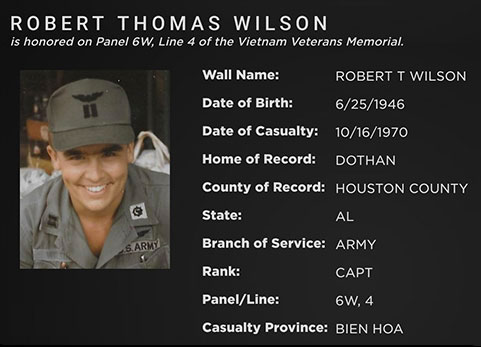
Stories Comments Off on How I Started My Flying Career – by Bill Cox Stories Comments Off on How I Started My Flying Career – by Bill Cox Stories Comments Off on Army Pilot, CPT Robert Thomas Wilson Honored at the Vietnam Veterans Memorial, Panel 6W, Line 4.
 Stories Comments Off on One of my Aviation Dads with my First Flying Job Stories Comments Off on Robert Thomas White, Vietnam POW
 ROBERT THOMAS WHITE
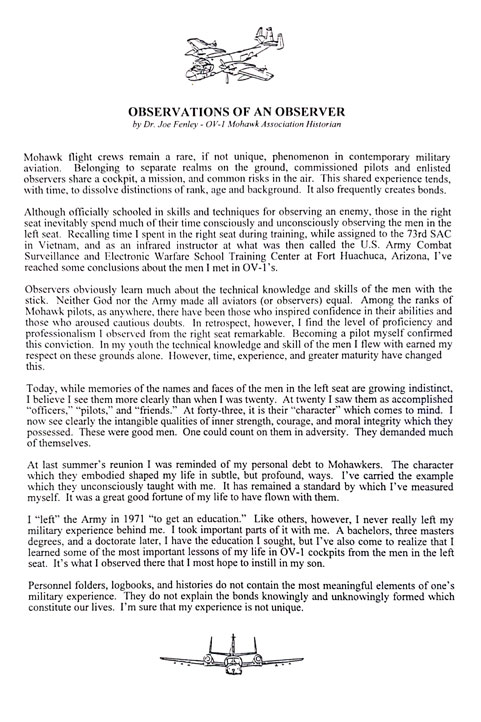
MOHAWK PILOT, 73RD SAC
LAST POW RELEASED FROM VIETNAM
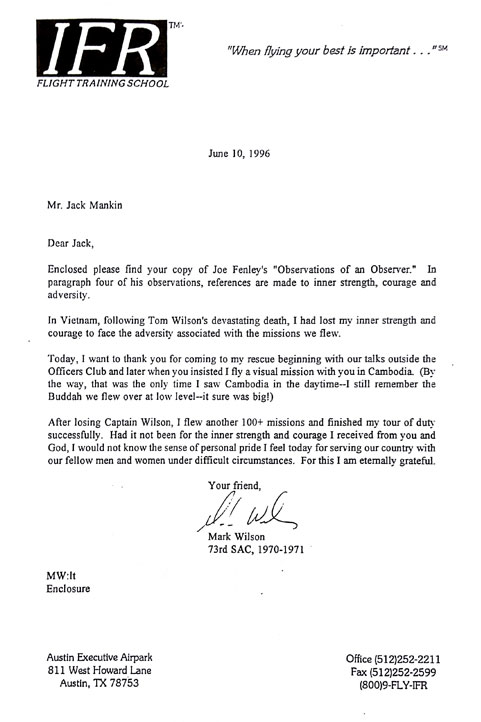
Robert White served in my unit, the 73rd SAC. His living quarters became a 4′ wide x 6 1/2′ long x 4′ high cage. Below is his story. God bless you CPT White for the extreme hardship you endured on behalf of our country. Mark Wilson
SOURCE: WE CAME HOME copyright 1977
Captain and Mrs. Frederic A Wyatt (USNR Ret), Barbara Powers Wyatt, Editor P.O.W. Publications, 10250 Moorpark St., Toluca Lake, CA 91602
Text is reproduced as found in the original publication (including date and spelling errors).
ROBERT T. WHITE
Captain – United States Army
Shot Down: November 15, 1969
Released: April 1, 1973
I was born in Geneva, Illinois on the 17th of August 1940. In 1958 I graduated from high school in St. Charles, Illinois and then attended DePauw University, Greencastle, Indiana for 2 years.
I volunteered for the draft in November 1960 and completed my basic training at Ft. Leonard Wood, Missouri in February 1961. I was then assigned to Fitzsimmons General Hospital, Denver, Colorado until my separation from the service in September 1962.
In August 1965 I re-enlisted and completed basic training again at Ft. Leonard Wood in November 1965. I then attended Flight School at Ft. Wolters, Texas and Ft. Rucker, Alabama and graduated in August 1966 with the rank of Warrant Officer (WO1). Next I attended the Aircraft Maintenance Officer Course at Ft. Eustis, Virginia and upon graduation in December 1966, I was assigned to Vietnam in the 1st Cavalry Division from January 1967 to January 1968. I was commissioned December 1967. Back to the States and Ft. Eustis, Virginia from February 1968 to September 1968, I then attended the Fixed Wing Qualifications Course at Ft. Stewart, Georgia and Ft. Rucker, Alabama. I graduated in January 1969.
From January 1969 to June of that year I was assigned to Ft. Eustis, Virginia and then to OV-1 Transition at Ft. Rucker, Alabama and Ft. Huachuca, Arizona which I completed in September 1969. I was then assigned to the 1st Aviation Brigade in Vietnam in October 1969 and was captured on 15 November 1969.
I was flying a visual reconnaissance mission in an OV-1 Mohawk when I was hit by enemy ground fire. The aircraft caught fire and I ejected. At
approximately 0800 on 15 November 1969, I was captured. After two nights of marching, I was interned in a permanent POW camp. At that time there was one other American with me. The last time I saw this man was January 1970. From then until my release on 1 April 1973, I saw no other Americans and spoke no English.
Initially, I was fed three meals a day, which consisted of rice, fish, shrimp, and a green leafy vegetable. I was given tea and sugar. My diet was considerably better than one might expect. They wanted to use me for propaganda purposes. I was offered my freedom in exchange for a propaganda statement.
In February 1970, they built a cage for me. This was approximately 4′ x 6 1/2′ and 4′ high. I was to spend 19 months in this cage and one other like it. I was fed twice a day, usually nothing more than rice. I estimate that I spent 23 1/2 hours a day in those cages. 12 to 15 of those hours were spent in a leg iron. I urinated in a can under my bunk and emptied it once a day. In June 1970, I became extremely sick. I was given no medicine and the food was still inadequate. I was allowed no exercise. I lost about 35 pounds. I still bear the effects of that illness and may never fully recover from it.
1972 was a better year. We moved to a new camp, but this time there was no cage. I was given more freedom and the opportunity to work. I began working with my hands. I made 180 pairs of chopsticks some of which they sold for 10 cents a pair. Capitalism was taking roots. For my work, I received a new toothbrush, toothpaste, and a pair of sandals. I was given tobacco. I made a pipe. I carved a ring and an elephant for my wife. The last year of my captivity, I cooked for my guard and myself. I set bird snares and went for firewood. 32 birds, 4 squirrels, 2 weasels (one weasel got away) and rats and crabs found their way into my snares. My guard built a rat trap (which I saw fit to improve) that yielded about 150 rats. I kept one of the squirrels as a pet and named him Charlie. Ironically, he escaped the day before I began my journey to the release point.
The fact that I am alive and reasonably well today is no accident. It is
something that I worked for and earned. Once I determined what needed to be done to survive, I set about accomplishing it. The initial adjustment was extremely hard. There was a point when I fully expected to lose my mind. I was physically sick and extremely weak. I felt that I couldn’t cope with the reality of being a prisoner.
This is the philosophy that I adopted. I decided to live one day at a time,
one meal at a time. I occupied my mind by daydreaming and reliving the past. I tried to avoid thinking of the future, especially as it concerned my family. At all times, I attempted to be as cheerful, friendly, and sincere as I could toward my captors. I placed a great deal of importance on being cheerful. This was the key to maintaining my mental balance. Not only would dejection have been unhealthy for me but it would have done serious damage to my relationship with my captors. I wanted to be accepted by them, and to earn their friendship and their respect. I tried to impress upon them that I was a human being and that I expected to be treated as a human being. I tried to convince them that I was neither superior to them nor inferior to them. What I sought was mutual respect. Their language became my language.
There was an obvious need to resolve the question of my religion. Prior to my capture I had been, at best, a part-time Christian. I had a very difficult time at first finding an answer to this question. Eventually, I did find the answer and reaffirmed my faith. I prayed for strength, wisdom and for my family’s well being. I prayed for peace. My prayers were answered.
Robert White retired from the United States Army as a Major. He and his wife Doreen reside in Colorado.
Stories Comments Off on Two Lives and One Mohawk Saved in Vietnam by Sharp Soldier by Ted Bedell,
Here’s the best of my recall on that stormy night (dramatic right?)
I drew the early mission that day with a new pilot, Capt X who had just finished his required training flights with Mr. Haliburton. I was training NCO at that time, and I was privilaged to be the first TO most new in country Vietnam Mohawk pilots flew with. We had recently acquired IV corps for some of our missions, and we were heading there. As we took off and turned toward our target, you couldn’t help but notice the huge storm directly in our path. I’m sure some thunderheads exceeded 35,000 ft, and it was so dark under the clouds I could see street lights on. I advised Capt X that we had time, and why not fly around the storm. He looked over at me and said, “Bedell, you operate the SLAR, and I’ll fly the plane..got it?”
Well, he flew right into the storm on our climb out to 8500 ft. Immediately, we began to get bounced all over the sky, and lightning was all around us. We must have been hit with the lightning because our instruments went out. We kept climbing, so I tightened my lap belt up and suddenly felt the plane roll over!
I looked over at Capt X and saw that he was staring at his wing indicator which had gone to a level position when the instruments went out. The standby attitude indicator came on and immediately showed our attitude relative to the ground. I looked at Capt X and hit him on the shoulder and pointed to the standby. He immediately looked back to the failed instrument. I figured he had vertigo. We were really in the thick of the storm. I hit him again and got his attention this time…he immediately tried to right the aircraft. Now we were heading down like a Kamikazee pilot, building up airspeed on the way. He was really struggling to pull the aircraft up, so I leaned over and helped him as punching out was not a good thing. We broke through between 300 to 400 ft, I hit the auto pilot, hit the live pilot again and told him to relax which he did.
We were slowing down to regular air speed when I called in to Saigon on guard frequency. They picked up our transponder and replied, “We thought you went down!” I took up a heading given to me, and we headed back to Bearcat. I mentioned to Capt X that I had landed (practice of course) at the Saigon Ton Son Nhat airport before with the auto pilot, and that if he would brake and steer after landing, we would be ok. He was recovered enough that he took us to our home base and landed.
Because of using guard frequency, practically my whole platoon was waiting for us to land. Capt X got all cocky again, and said to me, “Let’s get another plane and finish our mission.” I was insubordinate, and merely looked at him and said, “F— YOU, SIR! You are not safe to fly with others, and you don’t listen to instruction.” He yelled something about putting me on report. He went into TAC, Capt Fluff, our unit TAC officer and our Commanding Officer, LTC Holt were standing there. After I explained to LTC Holt how Capt X wouldn’t listen to my training instruction, he couldn’t wait until I walked through the door. He took CPT X into a cubicle and proceeded to dress him down pretty severely. When LTC Holt came out, he winked at me! (it probably helped me that I was the TO that took LTC Holt up usually twice a month to get his flight time in).
I admit, I was pretty shook up . I had been in country for over 9 months, and never came that close to buying it! I asked for reduced flight time after that, cause I was a short timer, had a wife and kid waiting to see me when I got home.
Side-note: I was sitting in the back of a duece and a half, getting ready to leave Bearcat for my flight home. Capt X was walking nearby, and I yelled out his name, snapped his picture, and said I always would remember him, He gave me a disgusted look and walked off.
Stories Comments Off on Meade River Operation – November 19 to December 9, 1968 3rd Platoon, Alpha Co, 1st Bn, 7th Marines Dear Garrett & Mark,
I have attached a short recollection of my memory of the events of my platoon’s involvement in Operation Meade River in Nov-Dec 1968. A guy is writing a story about our Battalion, and asked me, and others in our company, to write our memories. You may recall some of this from our “Walk through Vietnam” counseling/groups.
Several of the guys in my company and platoon send emails to me occasionally, and our company and battalion have reunions every year or so; I don’t go to the reunions any more, but did a couple of times.
– Ben
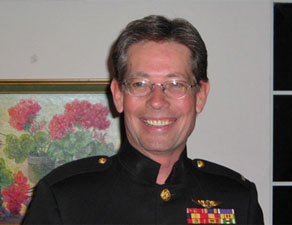
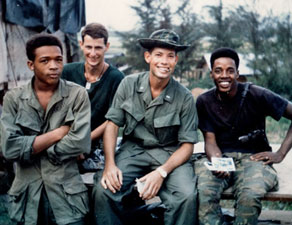
Meade River Operation – November 19 to December 9, 1968
3rd Platoon, Alpha Co, 1st Bn, 7th Marines
Memories of Ben J. Sorrell, 2nd Lt, Platoon Cmdr:
Our platoon kicked off our stage of the operation by humping from Hill 37 on Nov 19 to a blocking position on the north side of Song La Tho River, or the Suoi Co Ca River (I can’t remember which). As I recall, the bulk of the participants came in a massive airlift on Nov 20, but probably there were other units that also humped in to other positions around the cordon.
We stayed in the same general area until Thanksgiving Day. It rained frequently for the entire time we were on the operation. Our artillery, air and mortars had missions “softening up” the territory within the cordon throughout the days and nights. We would hear the artillery rounds, being fired from about half a mile north of us, whistling over our heads and exploding on targets just about 100 meters to the south of our positions. We always hoped that this next one coming would not be a short round! There were occasional mortar attacks from the NVA trapped somewhere south of the river, and less frequently random firearm rounds would come close. We knew they were close when we heard the “pop” of the bullet as it passed…then we would duck or move around to not be so easy a target. On Nov 22, five of our guys were wounded from one mortar round. I recall tracers from automatic weapons within the cordon firing at every airplane that took off from Danang Airport…but they didn’t dare fire up at “Puff the Magic Dragon” flying only a 1000 feet or so above them! As we watched “Puff” do his magic, I recall the treelines across the river just being disintegrated by the thousands of rounds per minute being fired.
On Nov 25, one of our guys caught a piece of shrapnel in his leg from a grenade that went off across the river! It was his third wound, so he left on the resupply chopper the morning of the 26th. My information was that 39 Marines had been killed on the operation to that date. On Thanksgiving Day, Division showed up with turkey and dressing and all the fixin’s, with CBS TV cameras there to record how well we were being treated. But, by the time our platoon got to the chow line, we got the word to move out, so we ended up eating rations again that day. Morale was pretty low that night. We were sent to the eastern end of the cordon, and positioned between two other units, one of which was ROK Marines. By morning, they were gone, leaving our flank unprotected, and a big gap in the cordon!
I don’t recall when we arrived on the south portion of the cordon, almost to the west end near the abandoned railroad berm. On Dec 3, we were at coordinates 000585. Lt. Huesner, platoon commander of 2nd platoon, was wounded when his radioman hit a booby trap. They were medivacced, which left me as the only Lt. in Alpha Company remaining in the field. That day I was informed that all of Alpha Company’s gear had been moved from Hill 10 to Hill 55, which would be our permanent base of operations after the conclusion of Operation Meade River. Around the 5th of December, I recall us finding some tunnels out in front of our lines. We threw some grenades down the hole, and three NVA or VC came out of the tunnel. Some weapons were also recovered.
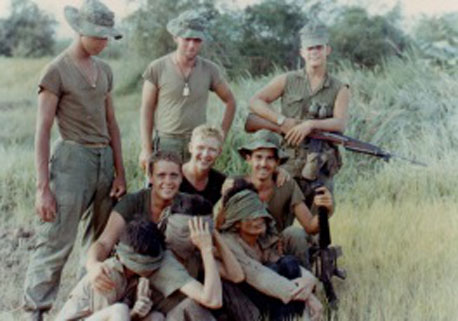
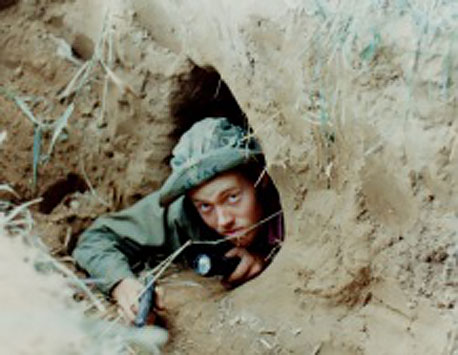
As you can see in the picture above, the terrain, while being generally flat, had a lot of grass and old rice fields that had not been tended for years, and in some areas earth berms that might be three or four feet high, with scrubby trees growing on the berms and paddy dikes. Interspersed there were bomb craters from months of dropping 500 pound bombs with delay fuses to try to collapse the tunnel system that ran throughout Dodge City. This was all a part of the NVA system to get rockets and personnel through the 7th Marines semi-circle around DaNang.
The next day, December 6, after we dug in for the night, on line as a company (I can’t recall which platoons were on our right or left), one of my squads opened fire on what they thought were gooks out front of their position. I asked Capt. Foster for permission to call in some artillery during the night to disrupt any plans that may have been in the making by the VC/NVA; but Foster thought it would be too risky to have artillery from Hill 55 or Hill 37, which would be firing directly toward us, and a long round might end up on top of us. We did get some light from artillery shells that would eject a parachute holding a bright white-phosphorous candle, but never could see any more movement.
At first light on Dec 7, the shit hit the fan! As the entire south side of the cordon moved out northward, on line, Mike Tyree’s squad was the first to move forward on our front. We began taking automatic weapon fire from all across our front, and Tyree and his men ran forward through the muddy rice field to a low dike that was the only cover between them and the trees from where all the fire was coming. He had some immediate casualties, Babe Pinole being one of the first to be killed, and LCpl Lanny Phipps.
At one point early on, I was standing behind a berm with Staff Sgt Flaherty from 2nd Platoon on our right flank, as we were assessing the situation. He was hit with a bullet and his left upper arm just seemed to explode, and was just hanging by some muscle tissue.
My radio operator was pinned down 30 ft or so west of me; I was trying to stay low down on my hands and knees as I was reporting the situation to Alpha 1, hollering back and forth. Suddenly I took a round through my upper left arm, but unlike Sgt Flaherty, it didn’t hit bone. I rolled a few times to get out of that line of fire!
At some point early on that morning, LCpl Lanny Phipps, Cpl Dan Phelps, Pfc Robert Pacheco had all tried to reach the machine gun position, and all three were killed by the crossfire from several positions behind the gun. The next day, when we recovered the bodies, Phipps had a grenade still in his hand, the pin already pulled.
Sometime during the day, while we were getting napalm out in front of us…closer than I like to remember seeing the canisters twisting and turning as they floated toward us…I was on my belly next to another Marine, trying to stay hidden in the long grass as we were pulling toward the rear another Marine who had taken rounds in both legs. Whomever was helping me took a round that hit both his wrists! Later in the day, I recall being pinned in a bomb crater as I was trying to get closer to the left side of the firefight, but by that time, we didn’t have much manpower left to fight with.
We also had 250# bombs dropped out front of us, and I recall seeing a large piece of shrapnel from a bomb fly through the air and hit a Marine flat in the back. If it had not been flat, it would have cut him in half. Even as it was, he had to be evacuated.
As dusk approached, the firing tapered off and some other unit moved in to reinforce us. The remainder of 3rd Platoon gathered to assess the damage (see the attached list of KIA and WIA I recorded in my green pad at the time). We had lost nine men killed and 15 wounded. I can’t remember those of us who were still there, but I think it was no more than 5 or 6. While we were eating some C-rations, a gook carrying an M-16 ran right up to our position…and we were all so shocked that we couldn’t get any weapons up before he took off down the line to our left. Shortly thereafter we heard several shots in that direction. I learned years later that machine gunner Ron Fiesler had seen him and killed him. The M-16 the gook was carrying belonged to one of our KIA’s.>
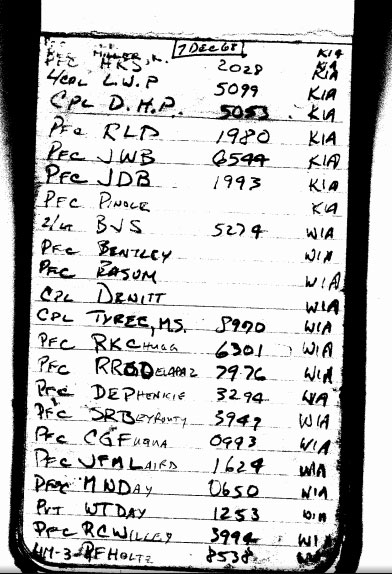
KIA & WIA
The next morning, Dec 8, we got the order to move forward, with some support from ARVN forces driving Armored Personnel Carriers. As we recovered our KIA’s, we put them aboard the vehicles…but not without having to force the ARVN to allow it. We didn’t meet much resistance that day…just some sniper and occasional automatic weapons fire; but the company to our right flank took 17 KIA’s, so this extended the operation for another day. It was late in the evening when our company made it to the river, which was the final objective of Operation Meade River. We discovered that the ARVN’s driving the APC’s had stolen all of our valuables, including my wallet, camera with 2 rolls of film taken on the operation, my address book, binoculars and shaving gear!
Most units still in the field had been taken out via helicopter during the day, but our platoon spent another mosquito infested night on the bank of the river before being lifted out the next day. While we were boarding the chopper, we were taking mortar rounds from the area of the operation!
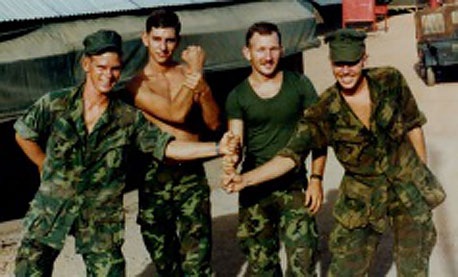
Here are some pictures of the 3rd Platoon before Meade River. Unfortunately I cannot remember all the names.
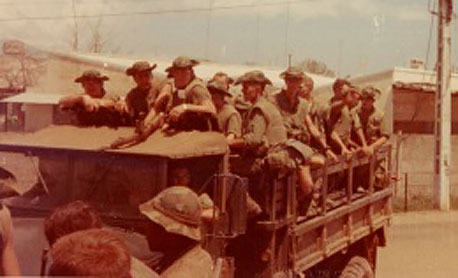
Heading to China Beach…around Oct, 1968
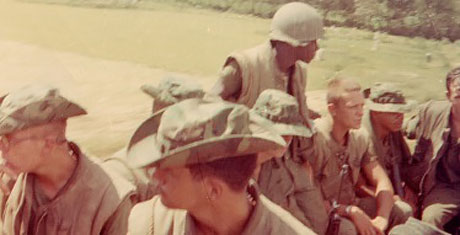
Pacheco in the front of the other truck.
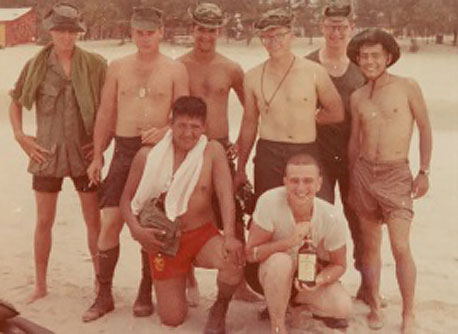
China Beach, around Oct, 1968. Standing L-R Cpl Humphrey, Cpl Phelps, Pfc Pacheco, Cpl Brewer, Pfc Chugg, Pfc Delapaz Kneeling L/Cpl “Chief” Sangster, Pfc Mizrachi
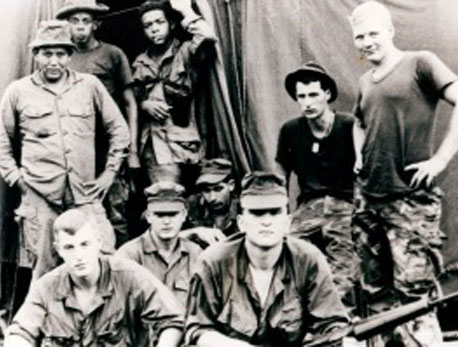
Tyree’s Squad? Back L-R Sangster, Williams, Day, Tyree, Fuqua, I remember the faces but can’t remember the rest of the names.
 Stories Comments Off on Your Brother Colin McGuire
 Your Brother, Colin McGuire
Dear Garrett,
You have a brother that you care about very much. His name is Colin. He is a famous football player, an incredible kicker. Below is a story about him written by a newspaper reporter. There have been many articles written, and will continue to be written about Colin and his amazing kicking ability.
I’m glad you get to go to his games. It’s extra special that you attend with Amy, your birth mother and Colin’s too. How Colin arrived on Earth and how we found a family for him is an exciting story. Colin is the kicker he is because of that family and because of Amy’s willingness to entrust the rearing of her birth son to that family. Later, I will tell the story of how all that happened. Below is a recent article about your brother Colin…Dad
By Danny Davis, Austin American Statesman Newspaper, August 22, 2012
At some point this season, Colin McGuire may hear his name called in the final minutes of the fourth quarter.
And Westwood’s senior kicker will run onto the field, meet his holder and face a kick that he may have made plenty of times before. There might be a deficit on the scoreboard, or there may be a tie. McGuire may be asked to just extend a Westwood lead.
And what will be going through McGuire’s head in those final moments?
“For some reason, it doesn’t click that it’s a high-pressure kick until after it’s done,” McGuire said. “I usually forget that there are people there watching me. Something weird in my brain, I have no idea.”
Westwood, ranked third in the American-Statesman’s preseason power poll, will have McGuire as its kicker for the third straight season. As a sophomore, he converted three field goal attempts. Last year, he earned third-team honors on the All-Central Texas Team after kicking eight field goals and 48 extra points.
McGuire’s longest kick was from 47 yards against McNeil last year. He estimates that he could reach 60 yards without any wind.
“With Colin, we think that if we can get the ball to the 30-yard line, we’ve got a great opportunity to get three points,” Westwood coach Anthony Wood said. “He does give you a dimension offensively that we believe is a weapon.”
McGuire started playing football in the seventh grade, but his career began in the secondary. In fact, he became a kicker only because he was the only one on his team at Grisham Middle School who could make an extra point.
Years later, he is the latest in a seemingly long line of successful kickers that have come through Westwood.
Former Oklahoma State kicker Jason Ricks and current Stanford kicker Jordan Williamson kicked at Westwood. Justin Putnam earned All-Central Texas honors as a punter and kicker in 2006.
“Coming in, I had big shoes to fill,” McGuire said. “It’s a big honor to be the next kicker.”
Wood, who is entering his eighth season as Westwood’s head coach, credited the success in the Warriors’ kicking game to the relationship between the incumbent and his successor. McGuire still kicks with Williamson during the summer, and he will be expected to pass the torch to freshman Josh Burton, Williamson’s younger brother.
“We believe that the outgoing kicker needs to train the kicker-to-be,” Wood said.
Like Ricks and Williamson, McGuire also will kick in college: He committed to Fresno State this summer.
But the Bulldogs didn’t come to Austin looking for McGuire.
In the offseason, Wood sat down with McGuire and his mother, and together they mapped out a list of colleges that would need a kicker in 2013. Emails were sent out, and McGuire attended camps at Fresno State, Arizona State, Baylor and Texas.
McGuire won kicking competitions at three of those camps, and his performance at the Fresno State camps garnered a scholarship offer.
“For kickers, you’ve got to go to the college camps,” McGuire said. “If you really step it up in the competitions and show that you can take pressure, that shows those coaches a lot.”
McGuire and his Westwood teammates are coming off a season in which Westwood won a school-record 10 games. A 52-20 victory over Bowie in the Class 5A, Division I playoff’s bi-district round gave the program its second postseason victory.
This fall, the Warriors return six starters on offense and another six starters on defense.
“I definitely think our program is on the rise, and there are a lot higher expectations for Westwood,” McGuire said. “People are a little more scared of what we can do.”
Stories Comments Off on Garrett’s First Bike Ride Without Training Wheels 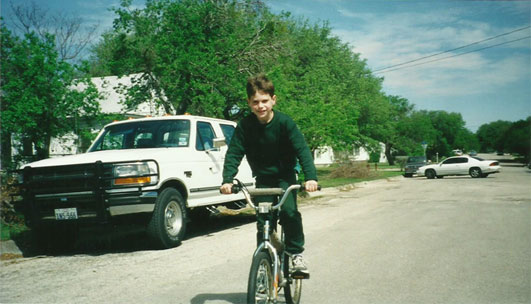
July 15, 2013
Dear Garrett,
Happy Birthday! This is your 22nd one on our beautiful planet Earth. I am told there are billions of galaxies. Our galaxy which we call Milky Way is simply one of many out there. It’s fun to think about where we have already been and where we will go when we leave here. God always has neat things in store for His children. He is more excited, supportive and proud of you than I am if you can imagine that!
I had this photo blown up on canvass and framed for your birthday present. I think you were age seven when it was taken. We were in Lampasas, Texas at our Lodge. What is special about this photo is that it was the first time you rode your bicycle without training wheels. I have entitled this photo, “I did it – I only had to try.”
We can do amazing things when we are simply willing to try. Sometimes we have to try a lot before we succeed at something. On this day, you only had to try once.
For about three years, I had been trying to get you to ride your bike without the training wheels. You always told me “No”, that you needed them on the bike. But I had been noticing that when you rode your bike the training wheel were not even touching the ground. But you continued to insist that the wheels stay on. No amount of talking would change your mind until one day I got a new idea.
With my new idea, I said, “Garrett, I have a deal for you.” Let me take off the training wheels – and you try to ride your bike without them – then if you want me to, I will put them back on. Quite surprisingly, you agreed to my offer – you were ready!
Within a few minutes I had removed the training wheels. Then you got back on your bike with me standing there to help you get started. I gave you a shove to get you going. Immediately you shot off in a streak of speed – you cut across the yard then down the street. You were going fast and your balance was perfect! This photo was taken on that first bike ride without your training wheels.
When came back from setting your new speed record down the street, I asked you to let me put the training wheels back on the bike. You would have nothing to do with that idea and off again you flashed down the street!
With this photo and letter explaining this important bike ride and event in your life, I am celebrating all the things you can accomplish in the future when you become willing to try. God has placed many wonderful gifts and talents in you. Your talents are simply waiting for you to try them out.
Since this bike ride you have accomplished lots of other neat things. It will be fun to see all the additional new things you will accomplish as you continue through your third decade on our amazing planet.
Love Always…Dad
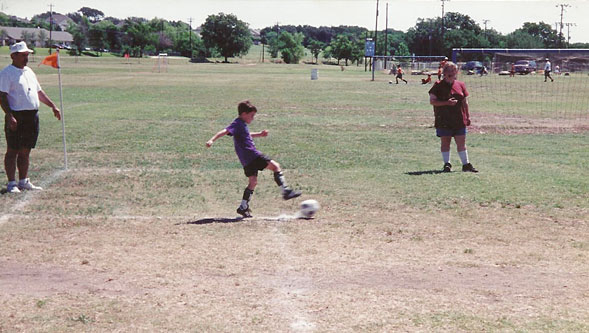
Stories Comments Off on Garrett’s First Coach Dear Garrett. I remember your first coach. You were about age five in kindergarten at Zion Lutheran School. You signed up to play soccer through the Georgetown City recreation program.
Your coach’s name was Henry. It was amazing to see how Henry coached the team. No matter what any player did, Henry constantly cheered them on. When a player made a mistake Henry cheered them on all the more. When a player made a mistake, it seemed a though it was immediately forgotten — or not even noticed. It was like they hadn’t even made a mistake! I witnessed Henry cheer each player out of every mistake that was ever made while playing your soccer games.
I was glad you were on Henry’s team. Dads like to see their sons nurtured with encouragement. Henry knew how to truly encourage. I don’t think he knew how to discourage a player at all. It seemed against his nature to discourage in any way.
I found a definition of the word “encourage”. It means to inspire or stimulate with assistance or approval. I was glad your first coach gave you that approval.
Henry reminds me of what I think God is like. I think God only encourages us — I don’t think He is ever discouraged with us no matter what we do, just like Henry.
You were the team goalie — remember? You did a great job with Henry’s constant encouragement. I’ll ask Rob to post your soccer photos below this story.
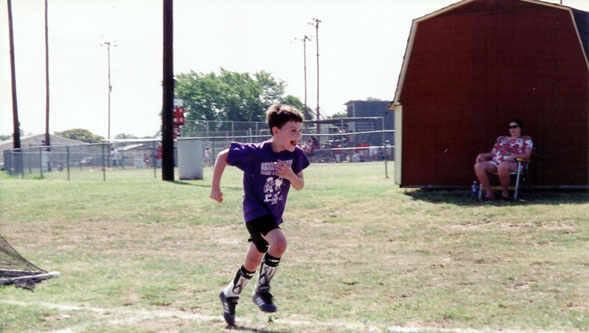
Garrett Playing Soccer
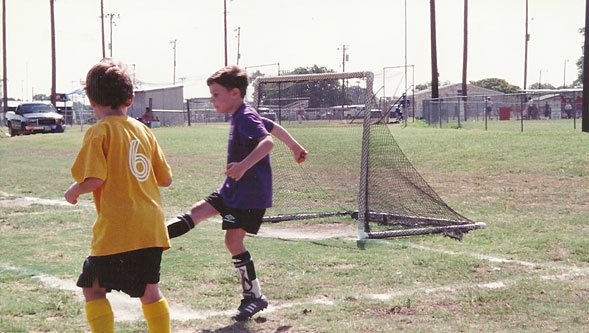
Garret Guarding the Goal
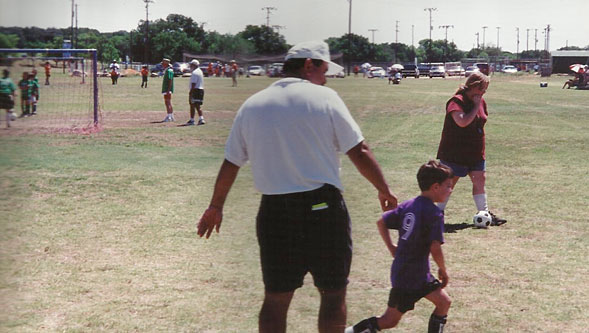
More Cheering from Coach Henry
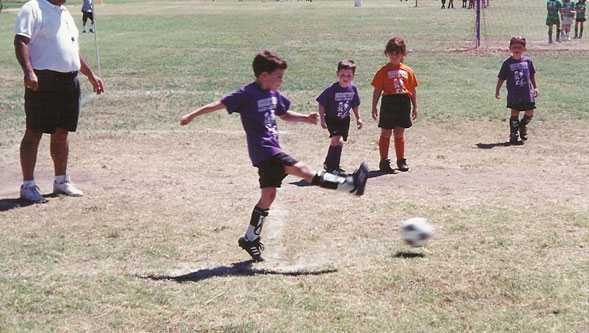
Garrett Kicking Off
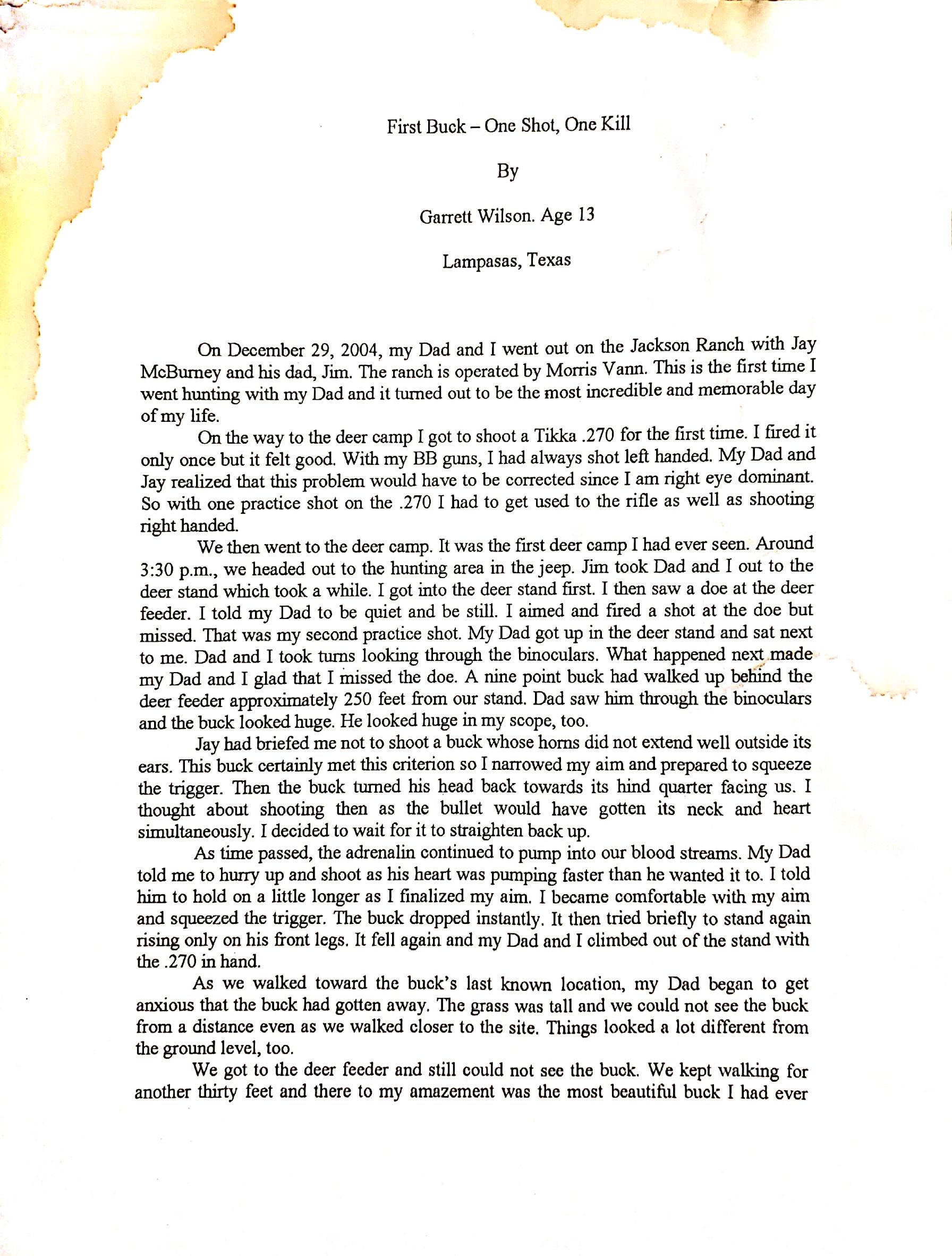
Stories Comments Off on Garrett’s first buck. Age 13, Lampasas, Texas